Standards
US fluid oz vs imperial: why the same name measures two different amounts
· 7 min read
Last updated
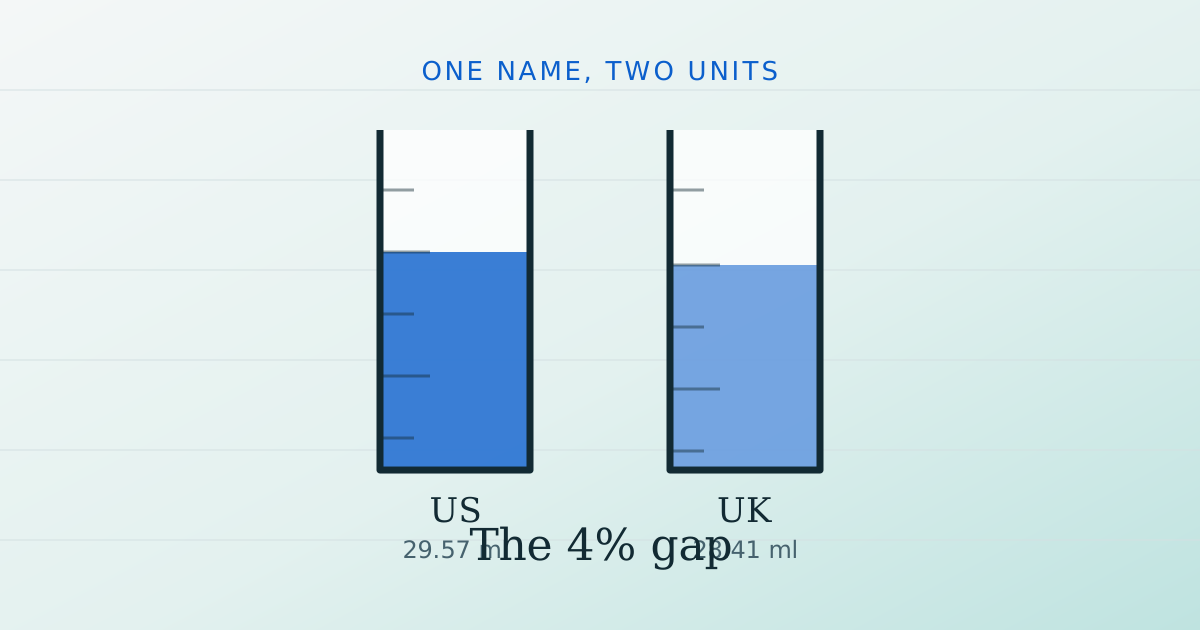
Ask an American and a Londoner to pour you a fluid oz and you will receive two different amounts of liquid. The American pours 29.5735 milliliters; the Londoner, if they are being historically rigorous, pours 28.4131. Same word, same abbreviation, printed on measuring cups on both sides of the Atlantic, different unit.
The 4% gap sounds academic until it compounds. Across the 20 oz of a British pint recipe it amounts to 23 missing milliliters; across a punch bowl it is a full glass. This is the story of how the oz split, where each version survives, and the practical rules for never mixing them up.
One gallon, two empires
Every English volume unit hangs off the gallon: 4 quarts to the gallon, 2 pints to the quart, and oz subdividing the pint. Before 1824 there was no single gallon but a small zoo of them, the wine gallon of 231 cubic inches, the ale gallon of 282, the corn gallon of 268.8, each defined by the trade that used it.
In 1824 Parliament swept the zoo away with the Weights and Measures Act, defining one imperial gallon as the volume of 10 pounds of distilled water. Elegant, rational, and adopted 41 years after American independence, so the United States simply kept the wine gallon it already used. From that single divergence, every downstream unit split: the US gallon (3.785 L) versus the imperial gallon (4.546 L), and eventually the two oz.
Why the gap is only 4% when the gallons differ by 20%
Here is the twist that catches everyone: the imperial gallon is 20% bigger than the US gallon, yet the imperial oz is 4% smaller than the US oz. The reconciliation is in the pint. An American pint holds 16 fluid oz; an imperial pint holds 20. Britain made the pint bigger and cut it into more, slightly smaller slices.
That is why the memorable pub fact, "a pint in London is bigger than a pint in New York", coexists with the imperial oz being the smaller unit. The imperial pint (568 ml) beats the US pint (473 ml) by volume while its oz loses by definition. Units are a system, and the system's pieces moved in opposite directions.
Where each oz survives today
The US customary fluid oz is very much alive: it is the legal labeling unit for American beverages, the unit on US measuring cups, and the default meaning of "fl oz" on the internet. The imperial oz is officially retired, the UK went metric for trade in 1995, but it lives on in older cookbooks, in draught beer (the 20 oz pint is still legally mandated), and in the muscle memory of anyone who learned to cook from a pre-metric Delia Smith.
Canada is the trap. Officially metric, it kept imperial habits informally, so a Canadian recipe from 1975 means imperial oz while a Canadian nutrition label today is metric. Australia and New Zealand skipped the ambiguity by adopting a clean 250 ml metric cup and abandoning the fluid oz entirely.
When the 4% actually matters
For a single cocktail or a cup of coffee, ignore the difference, 4% is less than the pour-to-pour variation of a human hand. It starts mattering when quantities scale or ratios are sensitive. Bread hydration calculated at 4% extra water crosses the line between a workable dough and a sticky one. A 20-oz British pint of stock read with US oz adds 23 ml, enough to thin a reduction sauce noticeably.
The compounding cases are worst: brewing, where a recipe's water, malt extract, and priming sugar all carry the error in the same direction, and infant formula, where the powder-to-water ratio is calibrated and the instructions may originate in either standard. For anything with a ratio on the label, identify the oz first.
How to tell which oz a source means
Three clues resolve almost every ambiguous source. First, geography and date: American sources always mean US oz; British sources before the 1980s mean imperial. Second, the pint test: if the text anywhere equates a pint with 20 oz, it is imperial; 16, it is American. Third, the bottle test: a source that calls 568 ml a pint or 1.136 liters a quart is imperial.
When a source stays stubbornly ambiguous, the stakes decide. Cooking: use US oz, since the modern recipe internet is American by default. Anything dosed, ratioed, or brewed: find a metric version of the recipe, because milliliters carry no ambiguity at all.
The metric escape hatch
The quiet lesson of the oz schism is that the milliliter never has this problem. One ml is one ml in every country, every decade, every cookbook. That is why Oz To Liter's converters expose both oz standards but do the math in liters, and why, if you cook from international sources regularly, a cheap metric measuring jug ends more arguments than any conversion chart.
Convert once, carefully, with the right standard, then work metric. Our oz to ml converter and the oz to liter tool both carry the US/UK toggle for exactly this first step.