Cooking
How to convert US recipes to metric without wrecking them
· 8 min read
Last updated
American recipes are written in a private dialect: cups, sticks, fluid oz, and the occasional "#10 can." The rest of the world cooks in grams and milliliters. Translating between the two is genuinely easy for liquids, genuinely dangerous for flour, and full of small traps everywhere else.
This is the conversion system we use ourselves: which ingredients convert by volume, which must convert by weight, the handful of factors worth memorizing, and the workflow that makes a converted recipe repeatable instead of approximately-right-once.
The one rule: liquids by volume, solids by weight
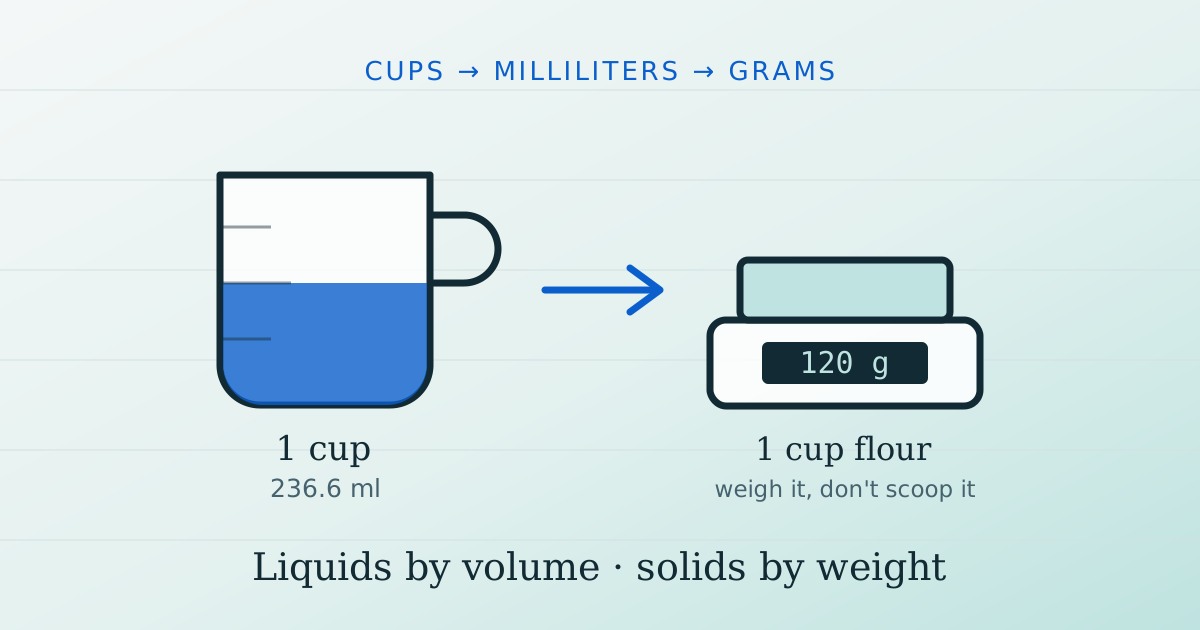
A cup of water is 236.6 ml in every kitchen on earth, volume converts to volume perfectly. A cup of flour, though, weighs anywhere from 110 to 155 grams depending on whether it was sifted, scooped, or packed, a 40% swing that no conversion factor can fix. The variable is not the cup; it is the compressibility of the ingredient.
So the entire craft reduces to one sorting decision: thin liquids (water, milk, stock, juice, melted butter, oil) convert with a factor; everything compressible or chunky (flour, sugar, cocoa, oats, nuts, cheese) converts via a standard weight table. When a metric recipe says 250 g of flour, it is not being fussy, it is being reproducible.
The liquid factors worth memorizing
Five numbers cover American liquid measure: 1 teaspoon = 5 ml, 1 tablespoon = 15 ml, 1 fluid oz = 29.57 ml (call it 30), 1 cup = 236.6 ml (call it 240), and 1 quart = 0.946 liters (call it 950 ml). Every US liquid measure is built from these, a pint is two cups, a gallon four quarts.
The rounding conventions are safe: recipes tolerate 1 to 2% easily, and rounded cups (240 ml) even match what nutrition labels legally use. The only liquid trap is the one covered in our US vs imperial oz article, a British recipe's fluid oz are 4% smaller, and its pint is 20 oz, not 16.
The dry-weight table that saves your baking
For dry goods, convert the ingredient, not the cup. The workhorse values: 1 cup all-purpose flour = 120 g (King Arthur's standard; some tables use 125), 1 cup granulated sugar = 200 g, 1 cup packed brown sugar = 220 g, 1 cup cocoa = 85 g, 1 cup rolled oats = 90 g, 1 cup shredded cheese = 113 g. Butter is mercifully standardized: one US stick is 4 oz by weight, exactly 113 grams, half a standard European 250 g block, near enough.
Two ingredients deserve extra respect. Salt varies enormously by crystal shape, a teaspoon of Diamond Crystal kosher weighs half what the same spoon of table salt does, so convert salt by grams whenever a baking recipe allows. And yeast: a US packet is 2¼ teaspoons, which is 7 grams of instant yeast.
Ovens, pans, and the conversions hiding around the recipe
The ingredient list is only half the translation. Oven temperatures convert as Fahrenheit to Celsius: the common anchors are 350°F = 175°C, 375°F = 190°C, 400°F = 200°C, and 425°F = 220°C, and if you have a fan oven, drop another 15 to 20°C. Pan sizes translate as 9×13 inches = 23×33 cm, a 9-inch round = 23 cm, and a standard loaf pan = 23×13 cm.
Watch for volume-labeled equipment too: an American "12-cup" Bundt pan is 2.8 liters, and slow-cooker recipes sized for a 6-quart model expect a 5.7-liter cooker. Our cups to liters and gallons to liters pages handle the odd-sized cases.
A workflow that makes conversions repeatable
Convert the whole recipe on paper before touching a bowl, mixed-unit cooking is where errors breed. Write liquids in milliliters using the exact factors, look up each dry ingredient's weight, and round everything to friendly numbers only at the end (237 ml of milk becomes 240; 113 g of butter stays 113 because butter is pre-marked). Then bake it once as written before scaling or modifying, so you know your conversion is the variable that worked.
For recipes you will make repeatedly, note the metric version directly on the recipe. The second conversion is where memory substitutes for math and the 20% errors sneak in.
The 30-second cheat sheet
Liquids: tsp 5 ml · tbsp 15 ml · fl oz 30 ml · cup 240 ml · quart 0.95 L · gallon 3.8 L. Dry: flour 120 g per cup · sugar 200 g · brown sugar 220 g · butter 113 g per stick · yeast 7 g per packet. Heat: 350°F is 175°C. Pans: 9×13 in is 23×33 cm. Everything else, convert live with the tools rather than from memory.
Print the oz to liter chart for the cabinet door, keep a scale on the counter, and American recipes stop being a dialect and start being dinner.