Hydration
How many liters of water a day? What the evidence actually says
· 8 min read
Last updated
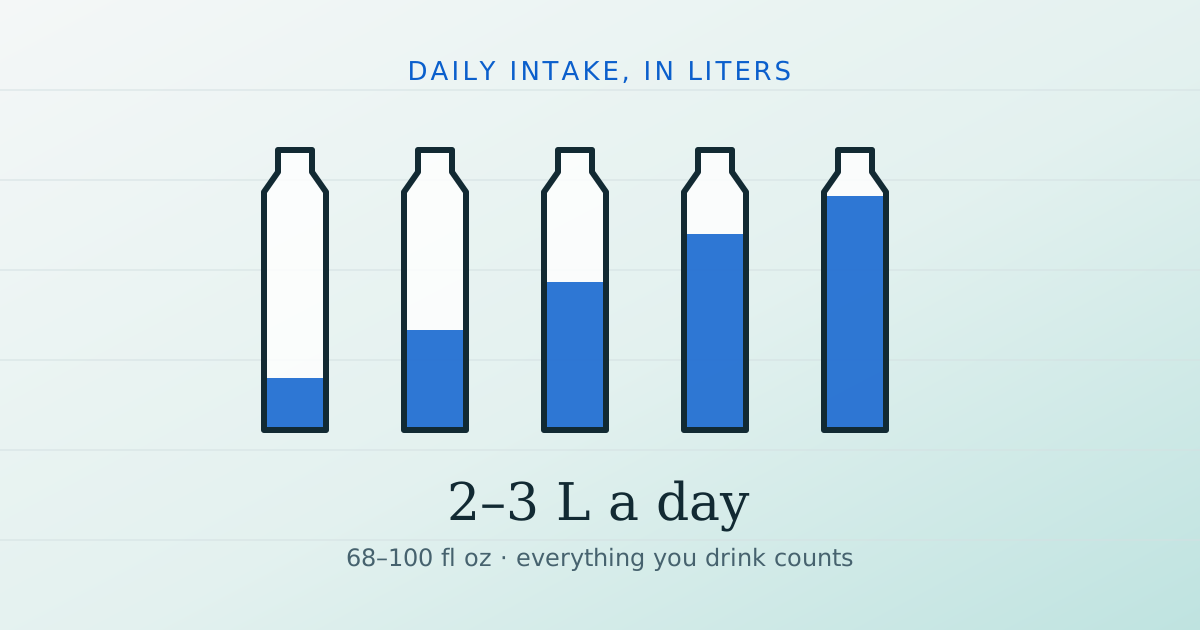
Somewhere between the "eight glasses a day" your grandmother cited and the influencer carrying a gallon jug, there is an actual evidence base for daily water intake. It is less tidy than either slogan, and once you convert everything into the same units, some popular targets turn out to be surprisingly arbitrary.
This is a units-first tour of hydration guidance: what the major health bodies actually recommend, where the folklore numbers came from, and how the liters on the guidance translate to the oz on your bottle.
What the official guidance actually says
The most-cited benchmark comes from the US National Academies of Sciences, Engineering, and Medicine: an adequate intake of about 3.7 liters (125 oz) of total water per day for adult men and 2.7 liters (91 oz) for adult women. The crucial, routinely dropped word is total, the figure includes water from food and from every beverage, not just plain water. Food alone typically contributes around 20%.
The European Food Safety Authority lands slightly lower, at 2.5 liters for men and 2.0 for women, with the same total-intake caveat. Subtract the food contribution and the actual drink target is roughly 2 to 3 liters (68 to 100 oz) depending on your size, climate, and activity, a range, not a commandment.
The 8×8 rule: a rounding artifact with staying power
"Eight 8-oz glasses a day" totals 64 oz, or 1.89 liters. Researchers who have hunted for its origin, most famously Heinz Valtin in the American Journal of Physiology, found no study behind it. The best guess is that a 1945 US recommendation of "1 milliliter per calorie" (about 2 liters for a 2, 000-calorie diet) got detached from its own footnote noting that most of it already comes from food.
As a slogan, 8×8 endures because it is memorable and roughly harmless: 1.9 liters of fluids is within the sensible range for many adults. As evidence, it is a rounding of a misreading. The 2-liter rule common in Europe is the same number wearing metric clothes.
The gallon challenge, converted
A US gallon is 3.785 liters, 128 oz. That is double the EFSA target for women and slightly above the National Academies' figure for men, before counting a single bite of food or cup of coffee. For a large, active man sweating through summer training, a gallon of total fluids can be reasonable; as a universal default it is simply oversized.
Overshooting is not automatically dangerous, healthy kidneys can process roughly 0.8 to 1 liter per hour, but chugging to hit an arbitrary jug line has a real failure mode: hyponatremia, the dilution of blood sodium, which is rare, but documented in marathoners and water-challenge participants. Thirst plus pale-yellow urine outperforms the jug as a target.
Does coffee count? (Yes.)
The persistent claim that caffeinated drinks dehydrate you does not survive measurement. Controlled studies, including a 2014 trial by Killer, Blannin, and Jeukendrup comparing coffee against equal volumes of water over three days, found no meaningful difference in hydration markers at ordinary consumption levels. Caffeine is a mild diuretic; the water in the cup more than covers it.
So a 12 oz (0.355 L) mug of coffee contributes 0.355 liters to your total, same as water. Milk, tea, and soup count too. Alcohol is the genuine exception: at beer strength it is roughly hydration-neutral, and above wine strength it costs more than it delivers.
Doing your own math in liters and oz
A defensible personal target: start at 2 liters (68 oz) of beverages if you are smaller or sedentary, 3 liters (100 oz) if you are larger or active, then adjust by thirst, urine color, and conditions. Add roughly 0.4 to 0.8 liters (13 to 27 oz) per hour of sweaty exercise, and more in heat or at altitude.
In bottle terms, the units that actually govern behavior, 2 liters is four 16.9 oz bottles or two 32 oz shakers; 3 liters is three 1-liter Nalgenes. Pick the container you already own, convert its size once with the oz to liter converter, and the daily count does itself.
The bottom line
Drink 2 to 3 liters of fluids a day depending on your body and your day; count everything you drink, including coffee; trust thirst more than slogans; and treat the gallon jug as a training accessory, not a health requirement. None of this requires an app, just a bottle whose size you know in both units.
And if you remember only one conversion from this article, make it the one that debunks the most marketing: 64 oz, the whole 8×8 target, is 1.9 liters, not some heroic volume. Your grandmother's advice was two large bottles of water.